
A Late Summer Harvest at PepperHarrow
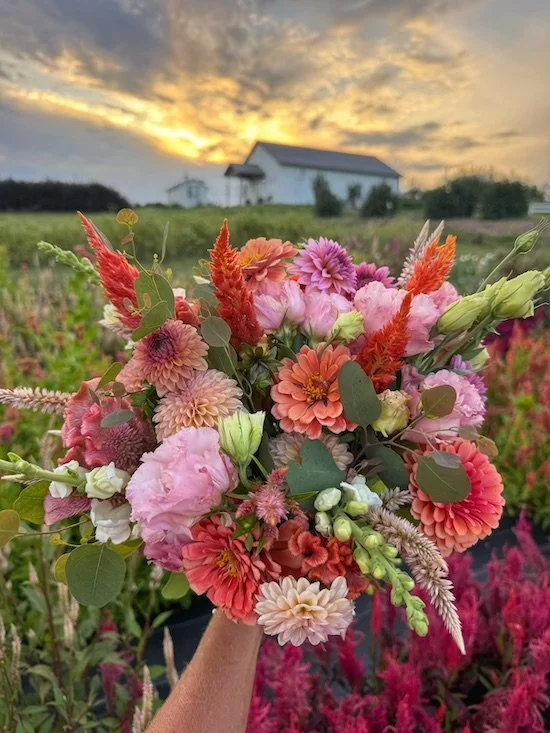
Some evenings the light does something that makes you hustle out to grab a bouquet of flowers, even though the day was hard, and you feel like you just want to sit in your easy chair. This bouquet, well, it was one of those. I'd been cutting in the celosia rows, the sun was going down behind the barn, and I looked at what was in my hand and thought, this is the whole season, right there in one bunch.
Y’all have asked for a bouquet ingredient list for several of our bouquets this season, so let's take a minute to walk through what’s in this beaut. If you've ever picked up one of our market bouquets or had a mixed arrangement delivered and wondered what exactly you were looking at, this is your answer.
Zinnias
The workhorse flower! The salmon blooms doing most of the heavy lifting here are Benary’s Giant Salmon Rose Zinnias, and if you want to understand why flower farmers plant them by the thousand, look at how they hold a bouquet together. They've got the full, layered petal structure that reads as "flower" from across a room, and they come in a range of warm tones that play well with almost everything else in the field.
One thing worth knowing: zinnias don't ripen after cutting. You have to harvest them right. We use the wiggle test, grab the stem about eight inches down and give it a shake. If the flower head flops around, it's not ready. If the stem stays rigid, cut it. That single trick is the difference between a zinnia that lasts a week and one that wilts on the drive home.
Dahlias
The rounded, geometric blooms in peach, copper, and cream are dahlias. These are the flowers people fall in love with, and I understand why, the petal arrangement is almost mathematical. The ones used here are PepperHarrow’s ‘Atlas’ varieties, but are not yet named. Be on the lookout when we release them online in early January for pre-sale.
Dahlias are also the most labor-intensive thing we grow. Tubers go in after last frost, they need staking, they need pinching, and in the fall we dig every one of them back up, divide them, and store them through an Iowa winter. It's a full year of work for a bloom that lasts about five days in a vase.
Worth it. Obviously!
Celosia
This is where it gets interesting, because celosia doesn't look like one plant. There are two distinct types in this bouquet.
Plume celosia is the flame-shaped orange and soft ivory/rose shades reaching up out of the top. Those are the ones that give an arrangement height and motion. In the field they look like something out of a coral reef. Shown in this bouquet are Sunday Orange and Starlight-a variety we bred at PepperHarrow.
Cockscomb celosia is the dense, velvety, folded mass on the left side, the one that looks almost like brain coral or a piece of fabric. People either love it immediately or find it deeply strange. I'm in the first camp. The texture is unlike anything else you can grow. Shown in this bouquet its our Pink Lemonade variety that we bred.
Lisianthus
The ruffled pink bloom in the lower left and the pale green buds scattered throughout are lisianthus. It kind of looks like a rose, but what a rose lacks in vase life, lisianthus makes up for it 3-fold. The vase life is exceptional. Ten days, sometimes two weeks, or more.
It's also one of the slowest, fussiest crops we grow. Seed to bloom can run five or six months. The seedlings are microscopic and slow growing, but once established, a single plant will send up wave after wave, and the unopened green buds are almost as beautiful as the open flowers.
Snapdragons
The pale creamy white spires with the tight buds running up the stem. Snapdragons give an arrangement vertical structure, they draw your eye up and out of the center mass. They also keep opening after you cut them, so a bouquet with snaps in it actually changes over the week you have it. The buds at the top will open days after the ones at the bottom. The variety shown here is Potomac White.
Eucalyptus
The round silver-green leaves are silver dollar eucalyptus, and the smaller-leafed stems with the seed pods are seeded eucalyptus. This is the foliage that makes a bouquet look finished instead of just full.
Greenery is the thing most people skip when they're arranging at home, and it's the thing that matters most. Foliage creates negative space. It gives the flowers room to breathe and keeps the eye from getting overwhelmed. It also smells incredible, which doesn't hurt.
PepperHarrow Farm is a 60-acre flower and lavender farm in Winterset, Iowa. Fresh bouquets are available in season — visit pepperharrowfarm.com for hours, events, and workshops.
Putting It Together
There's no exact formula here, but there is a logic: something with substance and mass (zinnias, dahlias), something with height and line (celosia plumes, snapdragons), something with texture (cockscomb, wheat celosia), something soft and unexpected (lisianthus), and greenery to hold the space between them all. Most importantly, all flowers that bring joy!
That's a good bouquet in any season. What changes is what's blooming.
Everything in this arrangement was cut the same evening, within just a few hundred feet of where I was standing when I took the photo. That's the part I don't take for granted, that the whole thing came out of ground we've been working for fifteen years now, and it will be back again next season, a little different, a little better.
Come see it while it's happening. The celosia rows are worth the drive on their own.
XX Jenn
